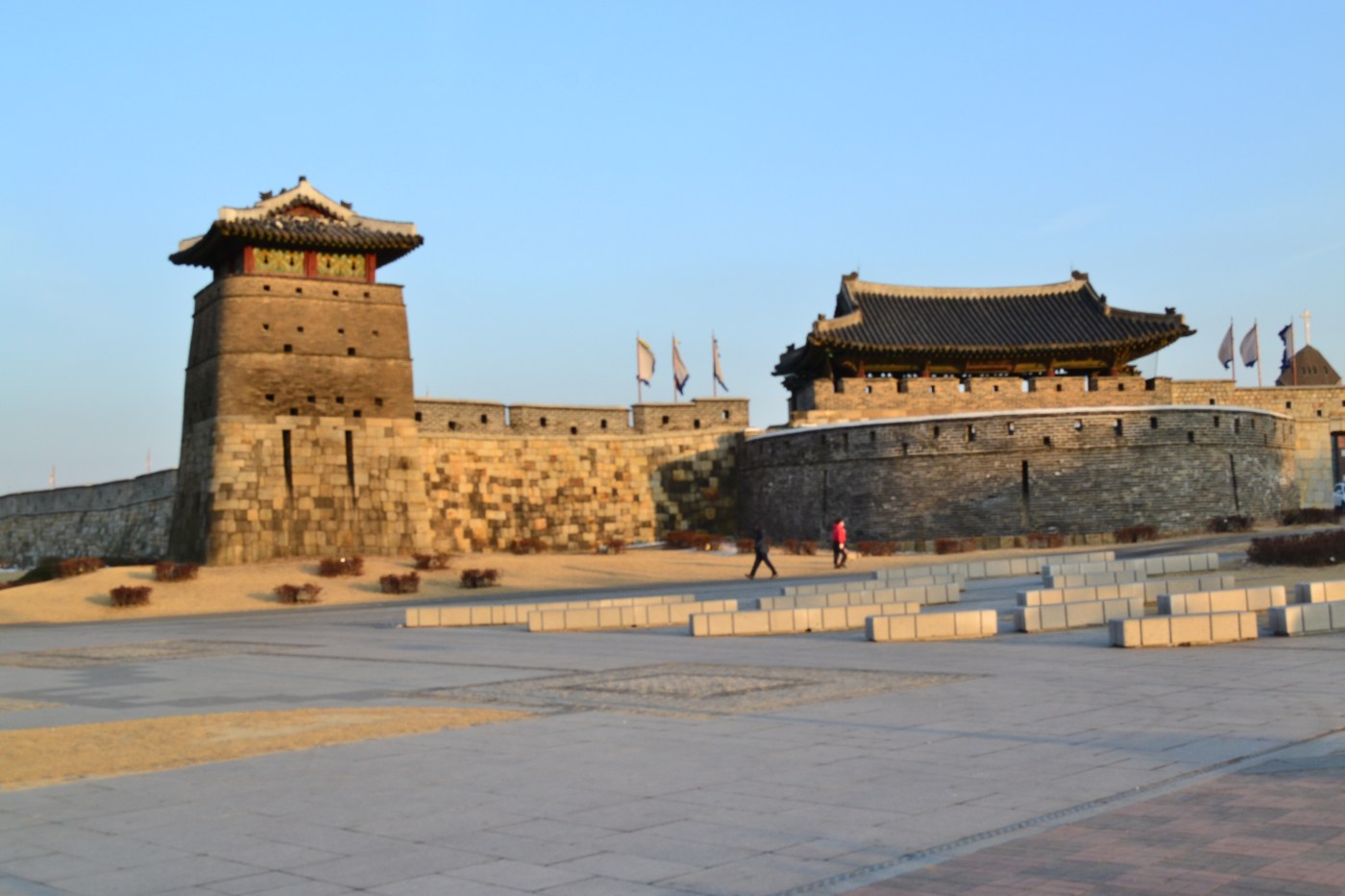
The last of the great fortresses to have been built during the Joseon Kingdom, Hwaseong is a faithfully restored, UNESCO World Heritage Site, and one of my favorite places to visit in Korea. It also helped that I was only a ten minute bus ride away and would spend many weekends walking its walls and taking an abundance of pictures with abandon. This may well be the start of a series of castle/fortress sites I explored in Korea, as I had visited over 50 such places during my time there.
Hwaseong was conceived by the Joseon king Jeongjo, as an attempt to reform his court, move the capital, and be closer to the tomb of his late father, Prince Sado. Ultimately many of the reforms fell short, but the king did succeed in building a nice leisure palace, called a haenggung, and frequented the fortress and tomb during his reign. The fortress is unique among Korean walled towns as the laborers were paid of compensated in some form rather than be drafted in. There are also a number of defensive features which are unique to the fortress and make use of the knowledge of canon and musket fire, all new innovations which were incorporated into the construction of the walls with special mini fortifications to add to its defense.
The best place to start a tour of the castle is from the South Gate, Paldalmun. This is a massive landmark turned traffic circle. There are a number of bus stops which will drop one off right at the gate which makes for a convenient start for the tour. The gate entrance is larger than the capital gateway in Seoul, highlighting the importance of this town. A bell is located in the tower, however I was never able to get access to it to confirm its existence but it was pointed out to me in several texts by the museum curators who were always very helpful. The main gate is protected with brick outer works called an ongseong, which covers the main gate from direct assault and also unique to the Hwaseong fortress completely encloses the gate. In recent years the entire structure has been closed off but it was once possible to brave the traffic to get up closer. Don’t be disappointed the North Gate is fully accessible, more on that later.
From Paldalmun, continue to your left if facing North towards Mt. Paldal, where the walls of the fortress work their way up the hill to the next series of defensive works. There are a number of drinking establishments located here so this is a good place to return to refresh oneself. Many expat friendly locations along the side streets as well, but I digress. The ticket booth is located here, but its more of an honor system, and there will be a few other places along the way where they will intercept you to confirm that you paid your fee. Note, if you are a resident of Suwon city the fee is waived. From the ticket booth the short hike commences to the first of many chi-seong, which are small bastions which stick out from the wall to protect it from direct assault. Working your way higher you come to the Namporu, or canon fort. Depending on the day, this may be unlocked and accessible. The aesthetics of the structure blend into the surrounding hillside and wall, and it is a great place to get some photos of the now distant Paldalmun among the buildings and street traffic below.
Continuing to the top of the hill of the hill is another interesting structure, or rather series of structures, the first of which is an Ammun, or hidden passage. This one though is not so hidden as it is topped with a guard tower. Korean pop fans may recognize this as the filming site for the “Gem in the Palace” period drama. The ‘secret’ passage opens up into an enclosed corridor, the Yongdo to the seonamgakru, also called Hwayangnu. The seonamgakru serves as an angle tower, and for those savvy in Korean may have already translated it as South West Angle Tower. In the winter months when the vegetation has been subdued by the cold Siberian winter this site offers excellent views of the city of Suwon. Its also a pleasant place to chat up with the locals who often rest here as well.
Back to the fortress proper, the hill was reserved for a lot of command and military storage buildings which are now long gone, however the hike from the ammun to the Seo-Jangdae offers additional fortress features and even a chance to ring a massive bell, for a small fee of course. If you missed picking up your ticket at the base of the hill, you can make up for it at the Peace Bell, without penalty. It used to be the first of the ticket booths before the one opened at the base of the hill, I recommend passing through the wall at the vehicle access point and traveling on the outside of the wall to have a slight change of scenery as the inside of the wall you only get he view of the parapet and forget that there is a wall below. I also challenge you to see if you can find the name plate carved into the stone from somewhere between the vehicle access cut and the next ammun where you can reenter the fortress. A little back story on name plates. These were to record who was responsible for the construction and maintenance of the wall section assigned. If this section of the wall failed before the next scheduled maintenance heads would roll. A practice which was meant to inspire quality.
Once reentering the fortress the Seo-Jangdae should to to the left. This was the western command center of the fortress, which the general could survey the surrounding area and direct his troops with flag commands. The entirety of the fortress and Suwon can be seen from here. It used to be that the upper floor would be accessible but this was a practice soon ended after I arrived and I swear i had nothing to do with it. The original structure was burnt down in a lightning strike many years ago, was restored and was again burnt down by a drunkard back in 2006. It was quickly restored with donations from the fortress foundation, which I also contributed a little to at the time. The Seo-Jangdae is also where the decent begins, which is a little steep here, and walking outside of the fortress is just as difficult. This part of the trek along the walls is also icy in the winter so use caution.
The next significant picturesque site is the Seobukgakru or North West Angle Tower. The views down to Hwaseomun shouldn’t be passed up.This place offers a nice place to get some good pictures of one of the wonders of Hwaseong fortress, the gate and observation tower. These tall towers are unique to Hwaseong fortress. Only two remain, the third was destroyed in a flood back in the 1920’s. From the Hwaseomun you can choose to explore the wall outside or inside the fortress. Outside you might be run over by the red dragon train, but you get to talk with the locals playing Go in the park built at the base of the wall. Inside of the fortress you can peer down from the high walls, the choice is yours, and you can always reenter once you arrive at the main gate. As I had lived in Suwon for ten years I alternated depending on my mood. One recommendation is definitely view the outside of the fortress here before venturing on inside if you choose to remain along the top of the wall. Excellent pictures can be taken with the gate and tower frames well. Also, tip, there is another name plate carved into the wall somewhere along this part to find if you are up to searching for it.
Janganmun, the largest of the city gates in Korea, is not to be missed. In the reconstruction of the wall a few plates were placed to show the history of the site, from the bomb damage the gate house sustained in the Korean War, to the development of the neighborhood surrounding the structure and its restoration. This gate is also open to the public (after all it is a reproduction so not as much concern about the damage to mass tourism. After the arson attack on Namdaemun in Seoul additional screens and sensors were placed on the site, but they have attempted to prevent them from obscuring the view. The walk along the ongseong is also open during the regular hours of the ticket booths. Pro-tip, they go home around 6 pm, so after hours you can walk the entire stretch of the fortress without being asked for tickets. There are some reproduction canons on either side of the gate to play on as well, if that is something you fancy yourself doing.
From the Janganmun, the next important stop is the Hwahongmun and Banghwasuryujeong. This area is a must, as it has been the subject of poetry,local folklore, novellas, postage stamps and currency. A suggested plaque has been placed to show you which angle gets all those postcard perfect shots. The Dongbukgakru or Banghwasuryujeong as it is also called overlooks a small pond and is aesthetically in harmony with its surroundings. This site is picture perfect in all seasons, but best on a sunny day. Many regard it as the most beautiful structure in Hwaseong, its hard to disagree.
Further long the wall will come the Dong-Jangdae, or Eastern Command Post. There is an archery range which you can let loose a few arrows at targets, again for a fee, and also a nice public toilet is available. There will be a future post about Suwon and toilets, I promise. The Dong-Jangdae is placed in an area that was reserved for military use when the fortress was first constructed and is a good place to catch the surrounding sites. The observation tower nearby is often open as well and it is worth climbing the to the top. Word of caution, if you are tall you will need to stoop as there are many low areas to clonk your head on. To the east an interesting structure protrudes from the wall, between the tower and the Changryongmun called the Dongbuk-nodae. This is another feature unique to Hwaseong, as this was a dedicated site for a heavy crossbow. Some sources list it as a Hwacha launching pad, however in the museum the display shows a heavy crossbow/catapult setup.
I haven’t forgotten to remind you to look for nameplates, the next is located at Changryongmun, or the East gate. Its the most easily visible of the nameplates to find. I also neglected to suggest looking up to view the dragons and phoenixes painted overhead when passing through the gates. Again the choice to continue on from outside or inside the wall can be made here, and I suggest the inside as this will give you the best views and allow you to see whats up ahead. There are three more structures of note to view, the smoke signal station, the Dongnamgakru and the Namsumun. The latter is the newest reconstructed feature, the original was lost to a flood in the 1920’s.
Over the course of ten years of walking along its walls, often daily, I have very fond memories of this place. I hope that I will get to visit again, and enjoy the walls that were like a second home to me. The fortress was also a learning experience for me, as I found out just how little I knew about what I had always assumed about the UNESCO organization and the efforts behind the fortress committee in getting the listing of the fortress as an important cultural heritage site. The fortress was also my first experience of a Korean walled town and it certainly contrasted with what I knew of Japanese Castles.


 Lost in Linklandiya
Thank you for this insightful tour of the Hwaseong. Your love for Korean culture and appreciation of its fortresses show in this review. The nameplate feature of Hwaseong intrigued me. It contrasts the famous Chinese architecture with which I am familiar, where the builders are, for the most part, unknown and uncredited.
Your sidenote that the closing of the upper floor of the Seo-Jangdae wasn’t your fault made me laugh. My parents are certain that a sign posted at a hotel in China came as a direct result of my little brother’s antics.
LikeLike