Choeung Ek, the Killing Fields This is just one of many such sites around Phnom Pehn, and hundreds more can be found throughout the country, collectively known as ‘the Killing Fields.’ Some of the Killing Fields around Cambodia still remain undiscovered.
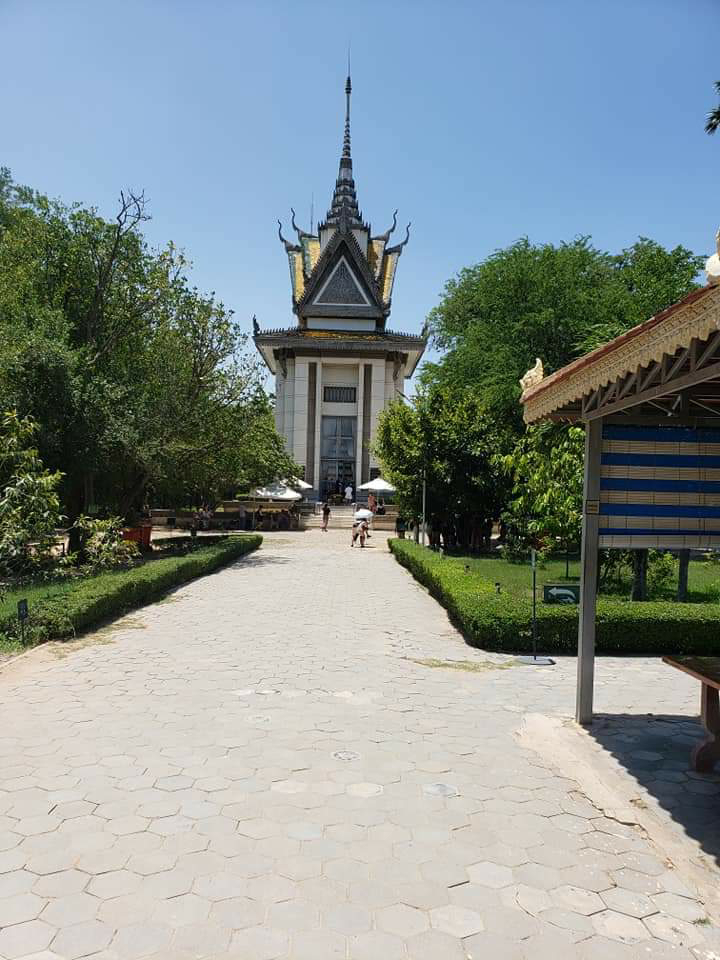
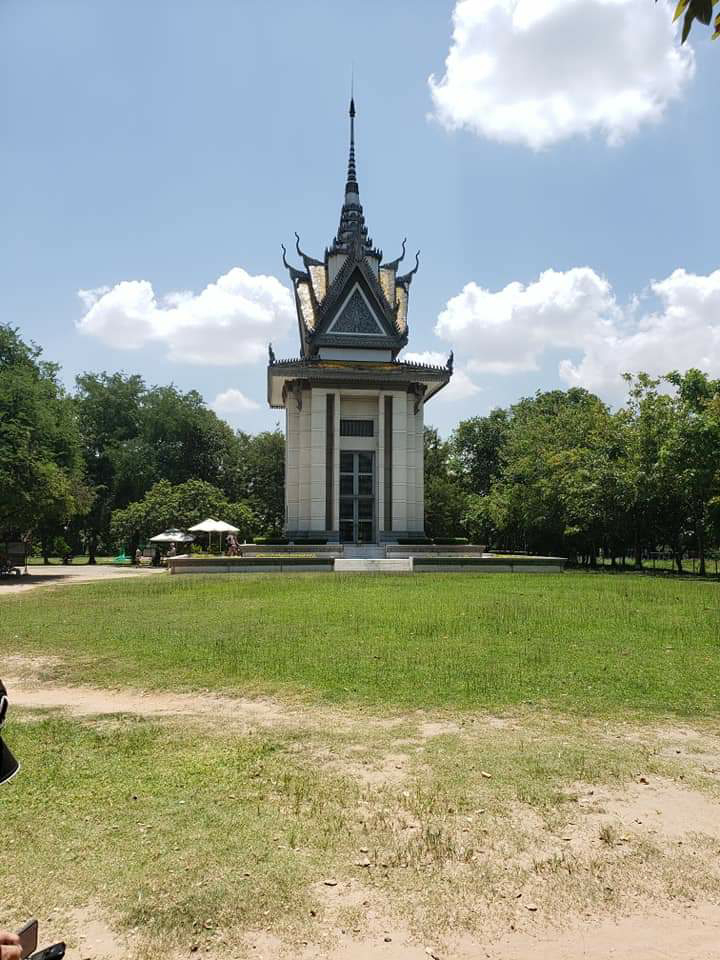
Choeung Ek is a dark place, and it requires some mental preparation before entering. I knew it would hit me hard, and I am a sensitive guy, so indeed, the totality of the place was overwhelming. It is hard to find the words which might best describe this place, so peaceful now, quiet and serene. The only visible distinguishing feature is a tall, unassuming Stupa, which only shows the horrors of the site when you are standing before it. From the distance, only the knowledge of what happened here betrays its secrets.
The entrance to the killing fields, just past the ticket stand to the right, a tall unassuming Stupa or pagoda greets visitors. Its sinister contents not yet visible.
The site was selected by the Khmer Rouge as it was already the grounds of a Chinese cemetery, the remains of a few Chinese style tombs can also be seen strewn about. The mass graves containing an estimated 8,895 bodies were discovered at Choeung Ek after the fall of the Khmer Rouge regime in January, 1979. Many of the victims were former political prisoners who were kept by the Khmer Rouge in the Tuol Sleng Detention Center and from other Cambodian detention centers run by the Khmer Rouge from 1975 right up to 1979.
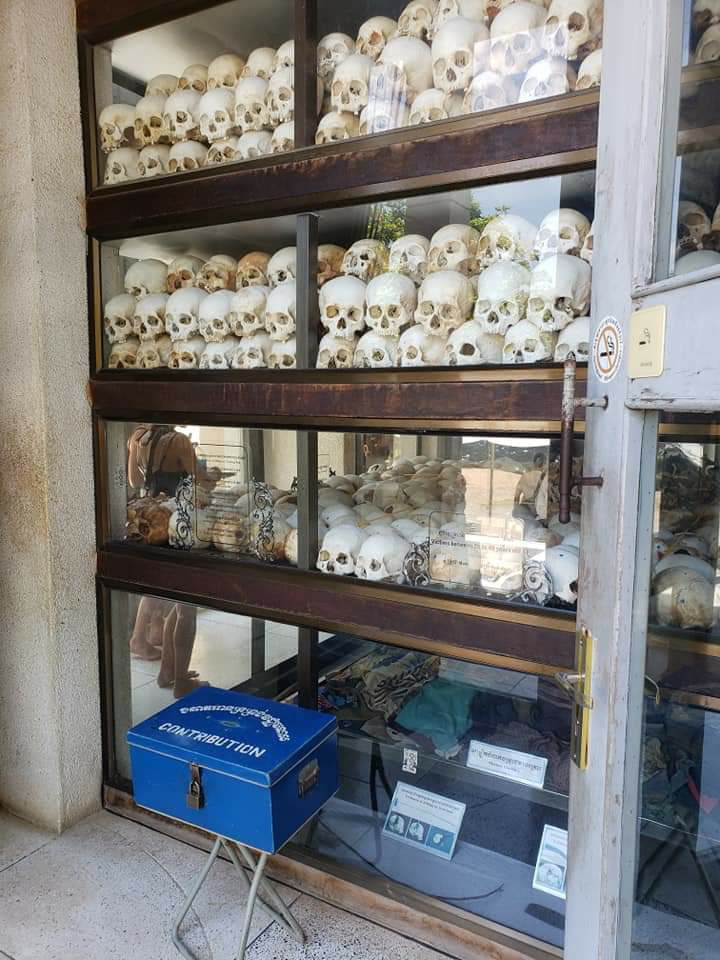
Once you have reached the monument, the true nature of the site is revealed. The display is challenging to our senses, and is difficult to take in. We are immediately confronted with the worst of our capacity to do harm upon others.
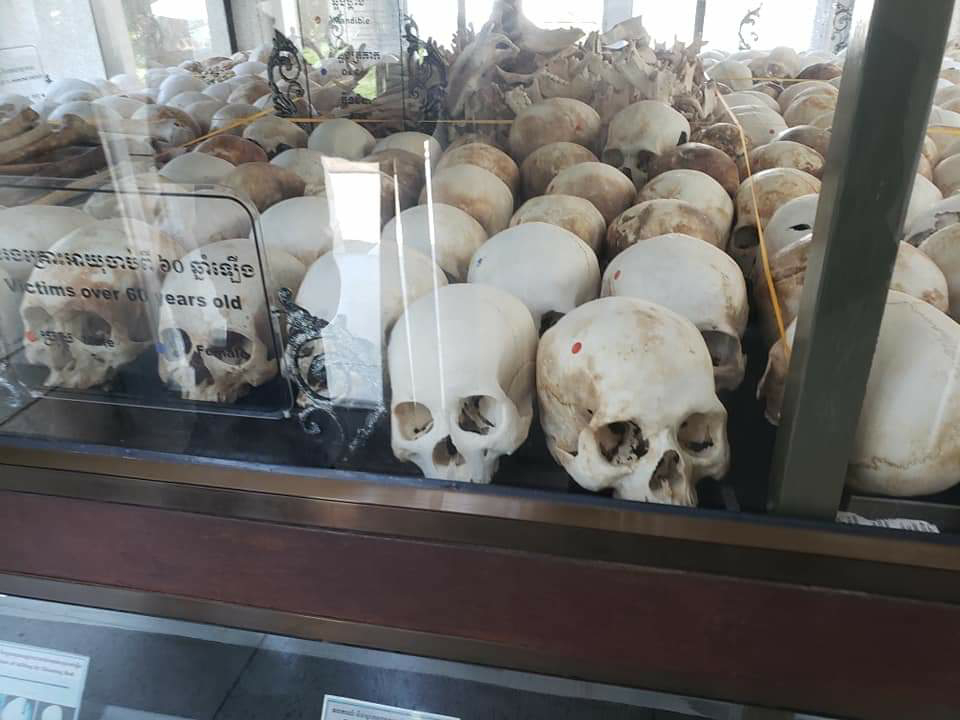
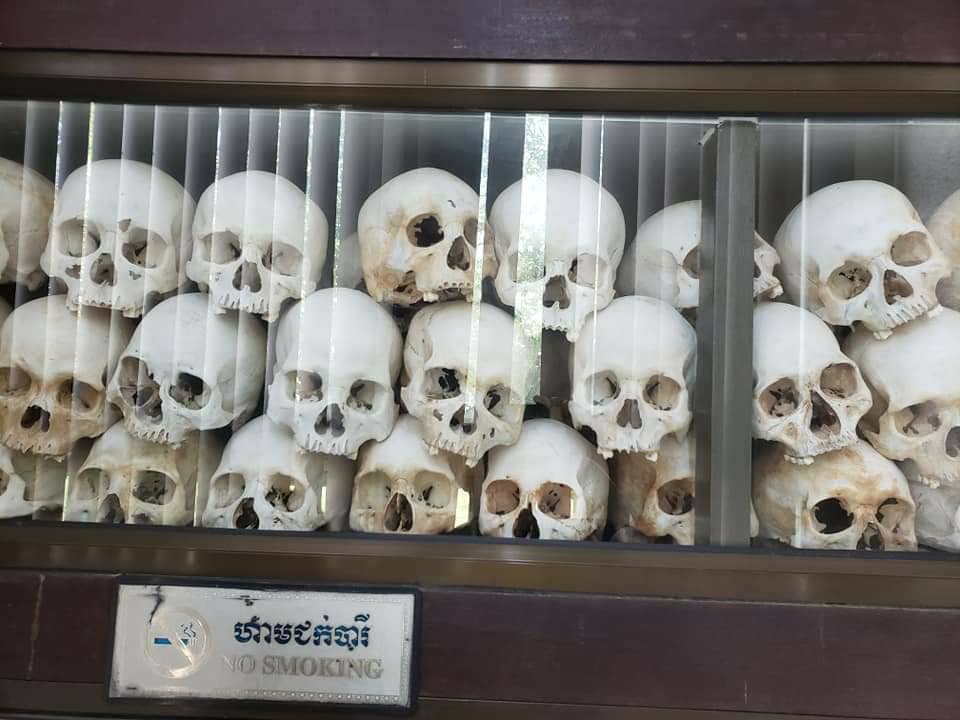
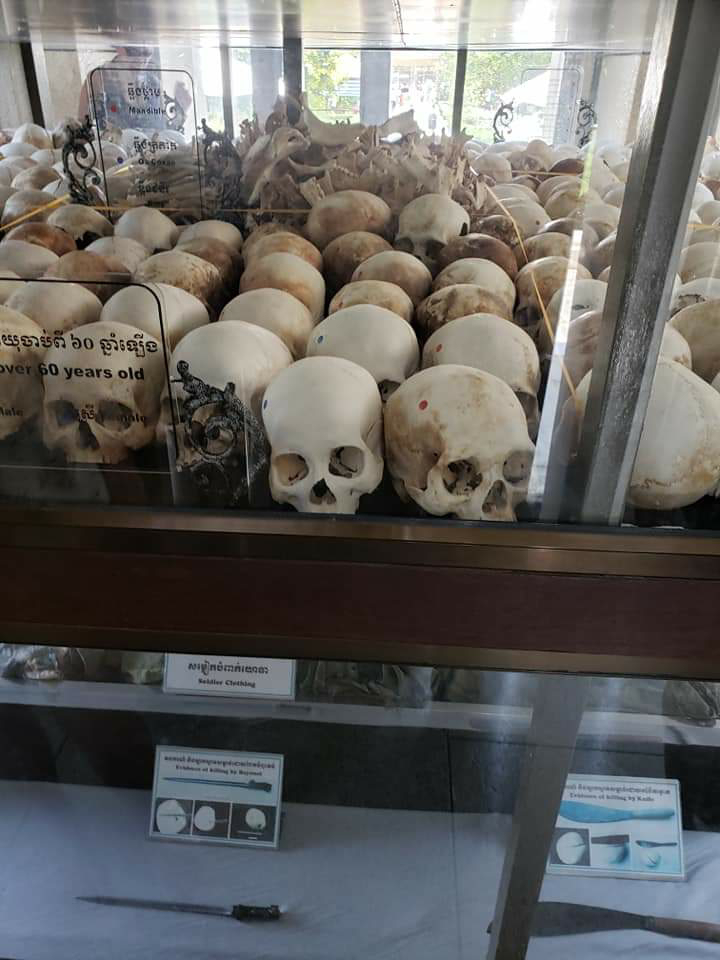
I was a little reluctant to take these photos, but its perhaps telling, how easy it was to continue taking them once that threshold was crossed. The skulls of the victims, marked with dots to help identify sex, bear signs of blunt force trauma or bayonet wounds. The oldest victims remains occupied the lower levels, with the younger above. The majority of the victims appear to be in their 20’s to 30’s. This memorial really pulls no punches and forces us to confront the grim realities of Choeung Ek.
the memorial Stupa holds 5000 skulls, all exhumed from the killing fields. These are the remains of the victims aged approximately 30 to 40. Guns were not often used in the execution practices of the Khmer Rouge, so most were led to their site of execution, and bludgeoned to death or had their throats slit. It was a grotesque way to die, with the indignity of state propaganda set to the tune of the Chinese propaganda music. The Khmer Rouge slogan often heard, “No gain in keeping, no loss in weeding out.” Such was the value of life under the Khmer Rouge.
Older victims, and the tools used in their execution. The monument to the victims spares no one, not even the curious dark tourism enthusiast. I don’t place myself amongst the crowd, but I do feel the truth to the statement that we are all “drawn to the macabre.”
I felt some comfort that I chose to to this, I have spend a fair amount of my time studying about the atrocities carried out during the time of Khmer Rouge, but only reading about it doesn’t always make the same connection which I was now confronted with.
We can’t simply deny what is in the ground ahead of us. I knew this was going to be a hit to my senses, and looking back I can still feel how shaken I was when I stepped out of the stupa and away from the memorial set up. But what was outside was equally disturbing.
Today, Choeung Ek is preserved as a national memorial, marked by a traditional stupa, as mentioned above, which is a common feature of many ancient Buddhist and Hindu temples throughout Southeast Asia. The stupa has acrylic glass sides and is filled with more than 5,000 human skulls, which have been labeled by sex and likely cause of death, with some of the types of weapons used for the execution of the prisoners kept at the lowest level. As can be seen in the images I posted above, many of the skulls have been shattered or smashed in. Many more show the blunt force trauma that likely ended their lives, one of the few times I wish I had not taken a few courses on physical anthropology.
In addition to the Memorial Stupa, a museum was also constructed off to the side which provided more information about the site and a few displays of the other artifacts retrieved from the site.
The uniform of the Khmer Rouge. Black with red and white checkered Khroma, or scarf, with the infamous rubber sandals. The rank and file would have also worn a green Mao cap, which was not included in this display. A very basic kit, but one that instilled fear into all who saw it.
When reading about the Khmer Rouge, many survivors always seem to fixate on the rubber sandals worn by the average cadre. The whole outfit is basic, but this was the uniform that won the war against the forces of Lon Nol.
These artifacts were retrieved during the exhumation of several of the grave sites. Because they are so numerous, it was decided to leave the rest of the mass graves in situ.
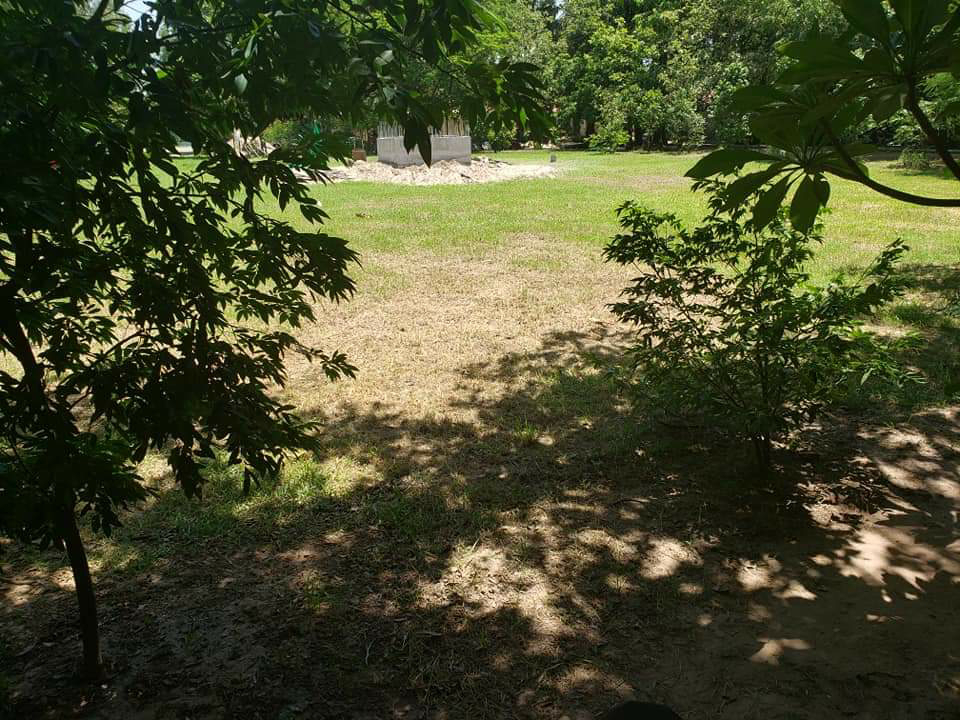
The old huts and buildings that were used for storage were located right where I was standing to take this picture of the Memorial Stupa. Some displays were located here as well to detail the purpose of the site and what basic structures existed here.
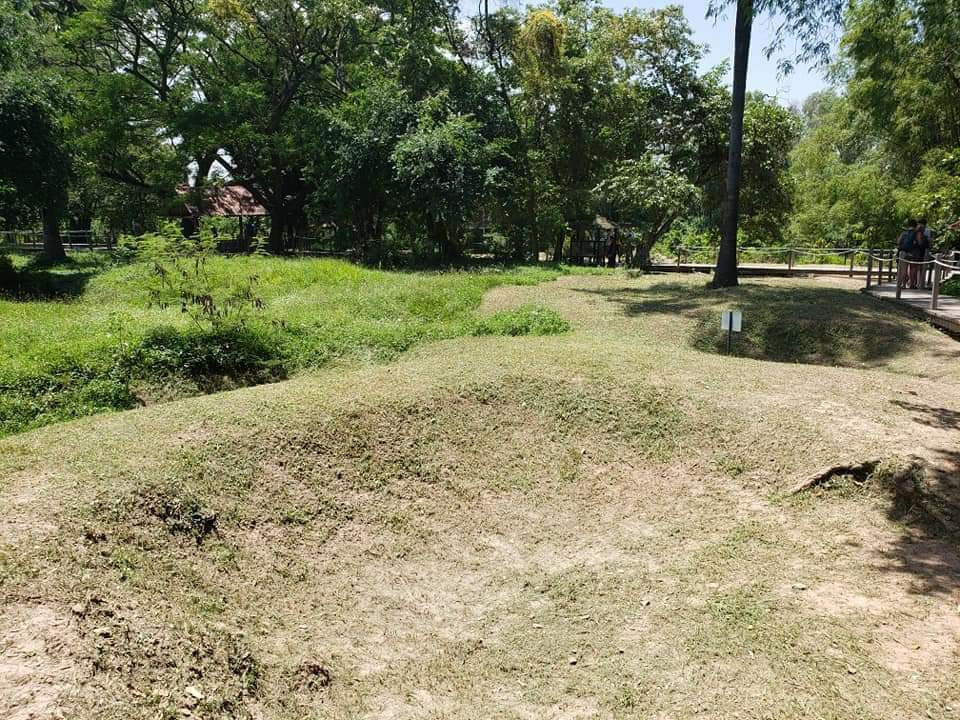
The first of the many pits excavated to come upon. After the victims were murdered, they would have been covered with chemicals to help mask the smell and then be covered with dirt. Anyone who would have miraculously survived bludgeoning and having their throats slit would have been snuffed out by the chemicals and earth. There are no known survivors of the killing fields.
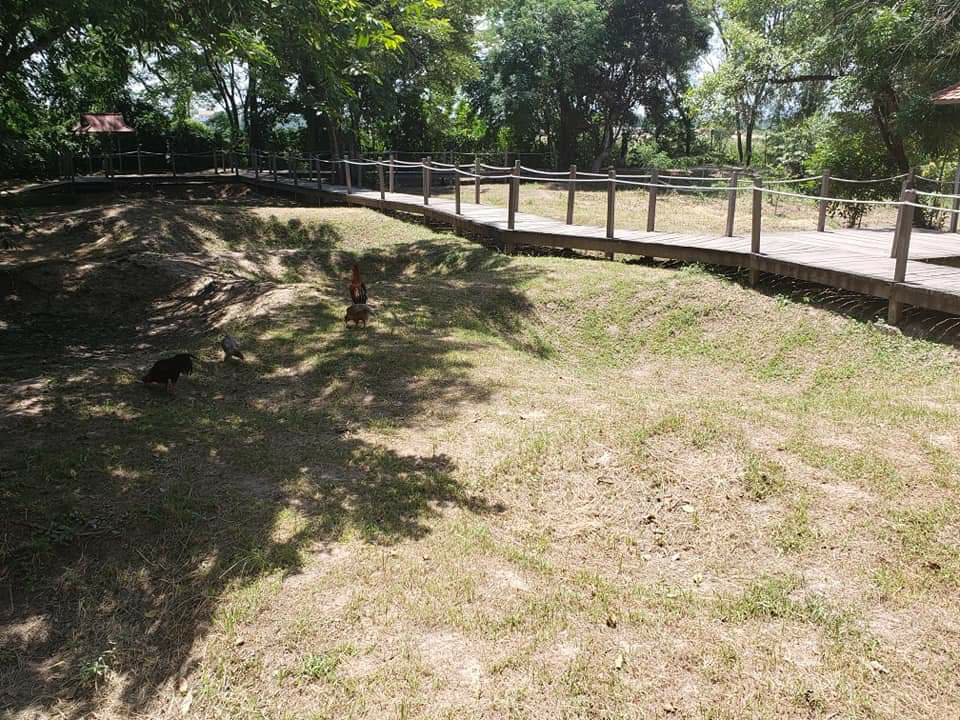
Pit after pit, after pit… The totality of what happened here really starts to weigh on you. Each of these mass graves held over a hundred victims. Even to this day, over 40 years later, scraps of clothing (usually blindfolds as many of the victims were stripped) and bone fragments will make their way to the surface. The constant rain and then drying of the ground moves the soil, forcing up the fragments to the surface. There are signs which clearly state to leave everything in situ. Every few months, the grounds are surveyed and any fragments found are retrieved.
A small pond at the base of the hillock that holds the majority of the mass graves. It was decided that those graves nearest to the pond would be left in situ and a dike was built to help preserve the site and prevent further flooding. This portion of the site was heavily degraded by the rains and erosion caused by the frequency of floods.
The other side of the pond. It was a good idea for me to use the time to listen to the testimonials of those who lived through the Khmer Rouge before continuing on to the rest of the site.
As stated above, the dike was constructed to help prevent further degradation to the site.
This is the area of the site which the mass graves were left undisturbed. Bone fragments and small scraps of cloth can be observed poking out from the ground in this area.
An excavated pit. The larger bones and other remains have been removed, but smaller fragments remain.
These mass graves have been excavated, but larger bone fragments are still recovered from time to time. There are a number of signs warning visitors to not retrieve them themselves.
Scraps of cloth and small bone fragments near the elevated guide way. The cloth was likely another example of a scrap used as a blindfold.
The site is littered with small scraps and remains like these shown.
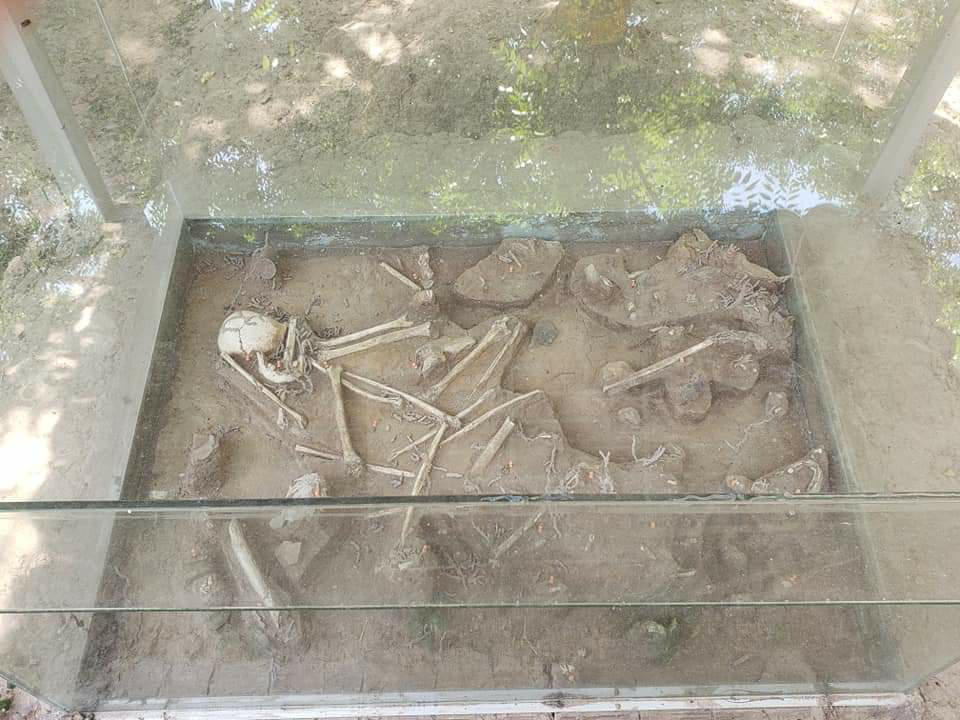
This grave was left in situ to help visitors visualize the difficulties that are faced in the recovery of the victim’s remains. Also observe how shallow many of the grave sites are.
Following the suggested route from the pamphlet I was given, I finally made my way to the one site which is often featured in discussions about the Khmer Rouge, the execution of Mother’s and babies. There is enough material published on these atrocities committed in the name of Angkar, the killing was merciless, babies ripped from their mothers, to have their heads dashed against a tree, then unceremoniously dumping the lifeless body into a pit. Reading about it is one thing, to come to the execution grounds and see the site where the atrocities were carried out was quite haunting for me.
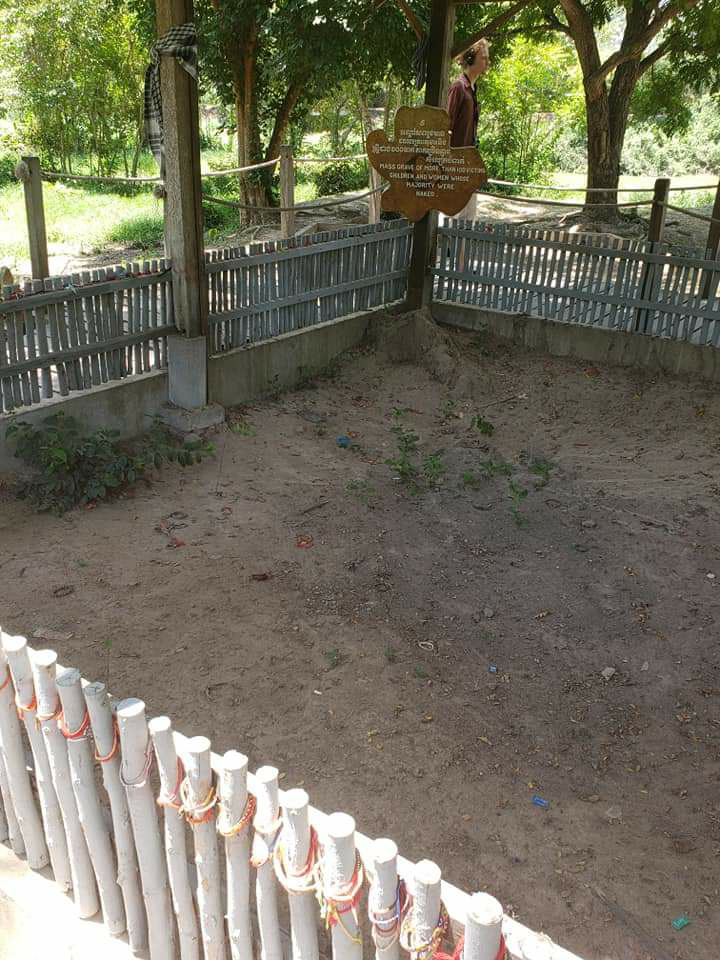
The mass grave of the mothers and children of Choeung Ek. The bodies of the executed were dumped here and in the nearby pits. Colorful peace bands have been left in offering to the countless victims here. This was I believe the largest of such mass graves on site.
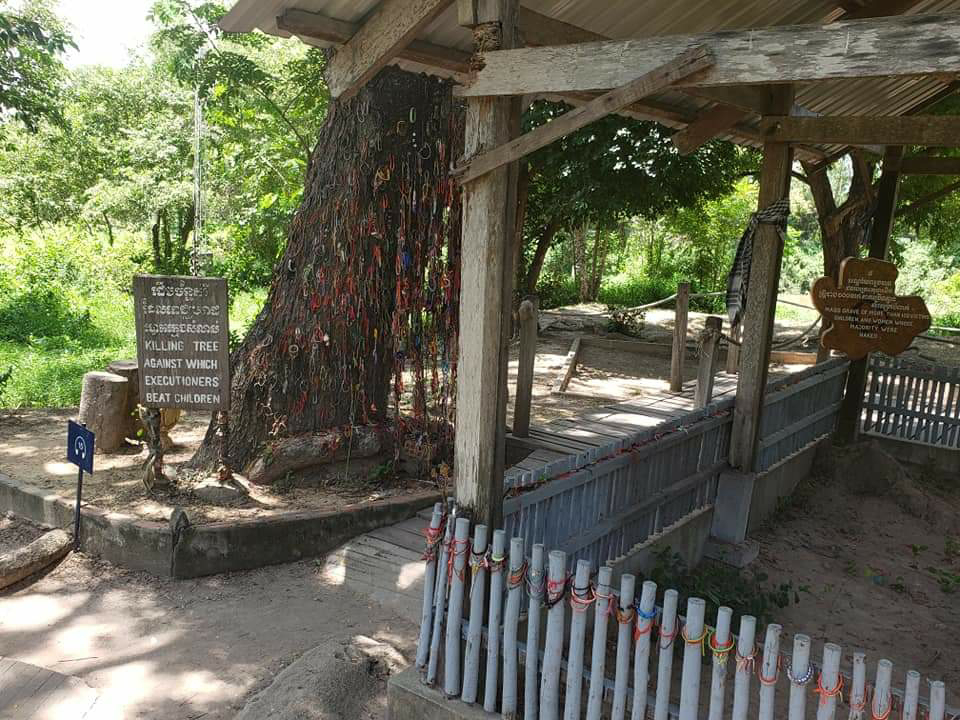
The Tree in the background is also adorn with colorful offerings, it is listed as the tree which was used for the execution of the children and babies.
The tree where these executions were carried out. The tree is adorn with many offerings as well. This was not an easy place to be in, and I was relieved that my visit was close to an end.
The peace and quiet of the site betrays the atrocities that were carried out here. The monument to the victims of the Khmer Rouge auto genocidal regime is an outwardly humble marker, to a very dark place. And yet, it restores a little bit of peace in my mind.
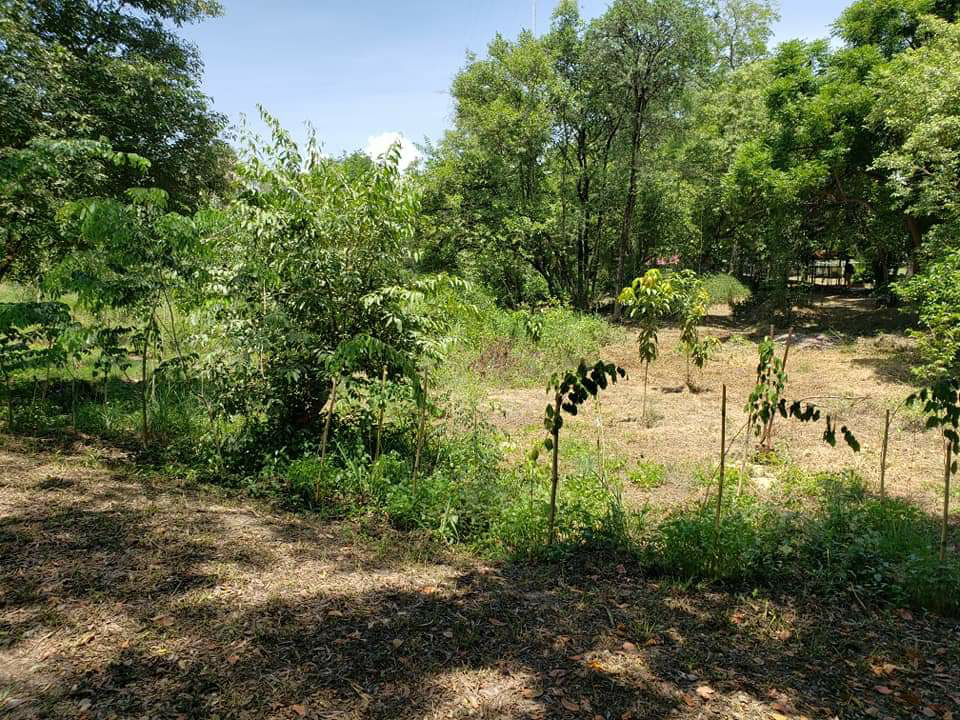
It feels like there is no end to the number of mass graves, many remain unexhumed at Choeung Ek.
The end of the path, and still more mounds off to the side.
Returning to the Stupa, and final offerings made to the victims.
Apart from the stupa, there are many pits from which the remains were exhumed. Human bones and scraps of clothing still litter the site, and as mentioned these are often pushed up from the ground from the constant moistening and drying of the soil. Every three months the grounds are inspected and bone fragments and clothing scraps are removed and placed in specially marked containers. There is little that can be done to try and identify the victims, so their identities are forever lost, and traditionally this is quite taboo. The site challenges many traditional burial practices but is a necessary reminder of the kind of brutality we are capable of, and to keep in place our checks on ourselves.
Additional details on Choeung Ek
On May 3, 2005, the Municipality of Phnom Penh announced that they had entered into a 30-year agreement with JC Royal Co. to develop the memorial at Choeung Ek. As part of the agreement, they are not to disturb the remains still present on site.
Choeung Ek requires some mental preparation before visiting, and it is a disturbingly dark place to visit. Not only does it challenge Khmer sensibilities and morals, but western ones as well. When I arrived I knew I was going to be shaken and once past the ticket booth and grabbing my audio guide, the impact of the place started to hit me. It was painful to listen to some of the stories of survivors of the Khmer Rouge era, no survivors of the killing fields here, this is a place of death and barbarism at a scale the reveals the worst of ourselves.













 Lost in Linklandiya
Leave a comment