Blitzing by the temple in the afternoon on the way to another site, I had reserved Angkor Wat for the next day, but I knew I was going to be in for a treat.
This is certainly one of those places that is on many travelers’ bucket list, and I also encourage that it should definitely be part of someone’s journey. I have a lot to unload on this particular place, its cultural importance, the good and bad tourists, and oh so much more.
There was a time when I thought that I would never fulfill my dream of visiting Angkor Wat, I had been momentarily content for some time to see the numerous Khmer ruins throughout Thailand, and I enjoyed them immensely, how much better it would be to see the yet unvisited gem that I created Angkor Wat to be. Life will definitely get in the way if you let it, and now that I had the means to get out and do it, I bought my tickets. By this point in time I had acquired more interest in the history and had read up sufficiently on Khmer history that it was time to see all the places that had to that point only lived in my head.
Waking up early to catch the sun rise over Angkor Wat was one of my earliest ambitions that I can recall. When I first arrived in Siem Reap, I promptly set out to get the required Angkor Park Pass, then settled into my hotel until on a whim I decided that I would venture out to Phnom Bakheng. The Tuk-tuk zipped on by the ruins of the western gate, but that was enough to keep me up most of the night in anticipation for what I was going to see in the morning. Part of it was anxiety, as I wanted Angkor Wat to be as I had dreamed it to be, and fearful that as with many hot tourist spots, it would be despoiled.
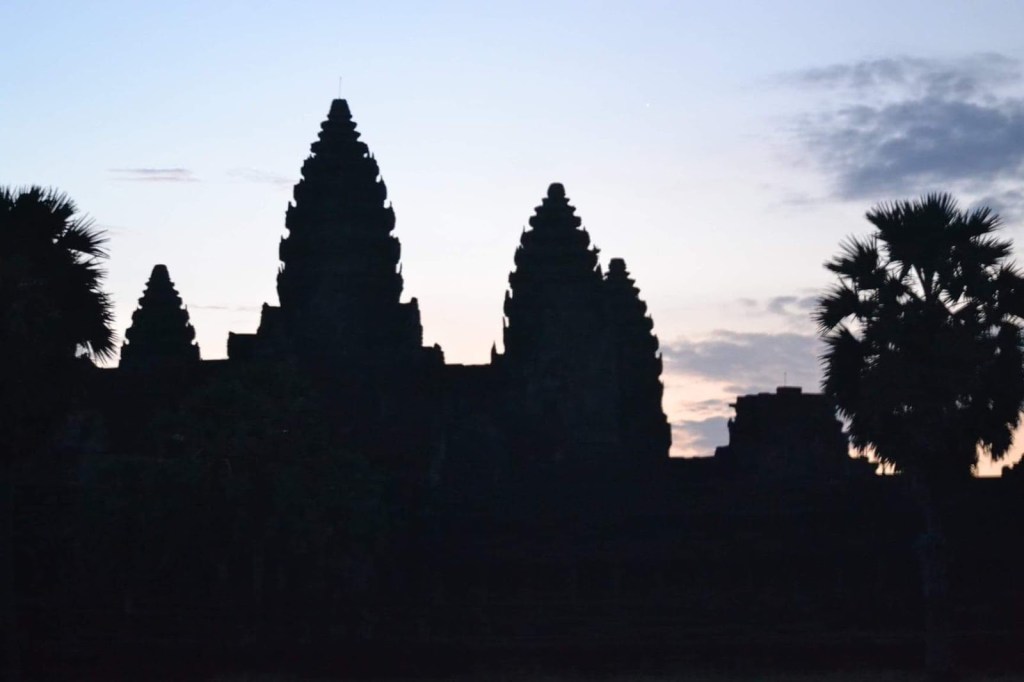
Sunrise over the Majestic Ruins
I am not a morning person, so waking up early and trudging over to witness the sunrise was no easy feat. But the view that greeted me was no disappointment. Years of waiting came to fruition and I finally made it, watching the sunrise behind Angkor Wat.
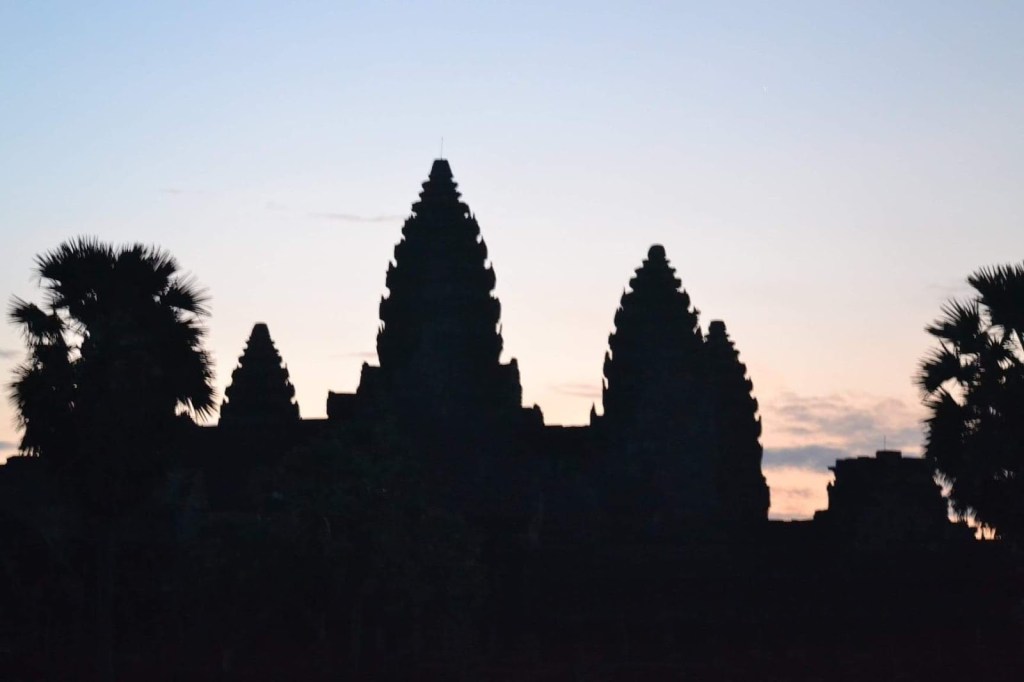
Another magnificent view of the sunrise.
I selected a spot behind the southern reflecting pond, to have my biscuits and fruit breakfast. Arriving early is recommended as the best spots will quickly fill up. After enjoying the temple come into view I looked back and saw the empty spaces behind me were filled with a mostly silent, awestruck crowd.I selected a spot behind the southern reflecting pond, to have my biscuits and fruit breakfast. Arriving early The light of the day started to penetrate the penumbra and revealed more of the temples intricate features.
There was a moment of relief when I stepped out of the Tuk-tuk and made my way across the floating bridge in the dark, I was finally making this happen. I had seen enough blogs and journals that others who had made the journey before me had posted, that I already had in my mind what I would be witnessing, new for me, but not new for the world. Even so, I was excited about the whole event and was happy to see I was early enough that I was able to have first choice on where I would set up. Then came the easy part, waiting.
While waiting for the sun to rise, I had a moment to reflect on what it was that had brought me here.
Getting to know Angkor Wat
A Jacques Cousteau quote that I feel really speaks to me, ‘We must go see for ourselves’ can pretty much sum up my thoughts on the importance of getting out there and doing the things that are on our bucket lists. For me, one of those places was Angkor Wat, and the city at the heart of the Khmer Empire, Angkor Thom.
My own awareness of the temples of the Angkor Empire came from an old National Geographic, the May 1982 edition, which had some fold out pages with the temples listed and articles covering the ongoing war being fought between the new government and the Vietnamese against the remnants of the Khmer Rouge. I don’t know why I treasured that copy, perhaps it was the massive lichen covered stone face with its enigmatic smile on the front cover, but it still remains on my shelves despite several moves, a decade living overseas, and the uncertainty of my post graduate life. In addition to the old National Geographic, which was the genesis of my obsession, I also acquired several more books on the Khmer Empire, and continued to nurture my interest in the history and construction of this colossal monument.
My interest was rekindled when I was browsing a local bookstore and a guide book came into view. It instantly reminded me of one of my childhood dreams to one day visit the various Khmer Empire ruins. Many of the temples were thoroughly covered and several had useful diagrams and labeling, which I have used repeatedly to assist in typing this out. Yet it was quite a few years later that I would eventually make good on my promise to myself. In the meantime, I continued my reading.
One thing that struck me was how with nearly every new king of the early Khmer Empire, the king would build a new capital city and mountain temple, which would then serve as a mortuary temple upon his demise. Generally these sites were settled in the general location of the plain where Angkor Wat lies today, and there are quite a few of these mountain temples and capitals dotted throughout the region, such as at Koh Ker, Hariharalaya and Yasodharapura, to name a few.
The temple was started by Suryavarman II, and was to serve as the state temple of Yasodharapura, though the original name is now lost to history. The name Yasodharapura would also be used for other capital sites within the region for the next four centuries. The temple broke with several of the established Brahman traditions in that unlike previous temples, Angkor Wat was originally dedicated to Vishnu, instead of Shiva. This may explain why the temple alignment was from the West to the East, which broke the long established pattern of East to West. After the Cham destroyed the old Empire, a new King, Jayavarman VII changed the state religion to Buddhism, and the temple was converted to a place of Buddhist worship. Over the years the succeeding kings attempted to reintroduce Brahmanism but by this time the populace was firmly Buddhist. The end of the golden age of the Khmer Empire came with the sacking of the city by the Siamese Ayutthaya Kingdom in 1431, and partial abandonment or depopulation which resulted from the turmoil.
Interestingly, one of the best contemporary accounts of Angkor Wat and Angkor Thom was by a Chinese diplomat, Zhou Daguan. Zhou was part of a delegation sent by the Yuan Emperor in 1296, where he lived in the Khmer capital and returned the following year. From his experiences he compiled his work, titled ‘The Customs of Cambodia‘ of which only fragments of this book remain. At first dismissed by many western scholars, Zhou’s account tells of a busy city teaming with life, a great metropolis with temples adorned with golden spires and strong earthen walled defenses. While Zhou’s account of the Khmer Empire is focused on Angkor Thom, then also known as Yasodharapura, it would be easy to imagine Angkor Wat would have been equally as grand. In his writing he described the royal palace “The Royal Palace stands to the North of the Golden Tower, lintels and columns, all decorated and carved with painted Buddhas are immense – the roofs, too are impressive, long colonnades and open corridors stretch away interlaced in harmonious relation.”
In 1586, a Portuguese missionary named Antonio de Magdalena was able to reach the site in the company of others, and it seems that after the sacking of the city by the Siamese that it didn’t take long for the jungle to reclaim the city. It appears that Magdalena was equally at a loss for words, as I was, when he described the temple ruins; “Half a league from this city is a temple. It is of such extraordinary construction that it is not possible to describe it with a pen. It is like no other building in the world; it has towers and decorations and all the refinements that human genius can conceive of.”
A French Naturalist, Henri Mouhot, and as shown – not the first westerner to visit the site, but perhaps because he wrote most evocatively about the ruins, more so than any of the previous European visitors, that he is often credited with introducing Angkor to western audiences. An example of his writing certainly evokes more fantasy than I can muster. Henri wrote “One of these temples, a rival to that of Solomon, and erected by some ancient Michael Angelo, might take an honorable place beside our most beautiful buildings. It is grander than anything left to us by Greece or Rome, and presents a sad contrast to the state of barbarism in which the nation is now plunged.” His account of the various ruins led to the popularization of Angkor, and an Angkor Wat/Khmer culture craze was started.
Angkor Wat represents the height of classical Khmer architecture and incorporates several architectural features, such as the stately temple-mountain and introduced the galleried-temple tradition. The mountain temple is an earthly representation of Mount Meru, home of the Devas in Hindu and Buddhist cosmology. Extensive bas-reliefs adorn the galleries, with various guardians and Devatas carved deep into the walls.
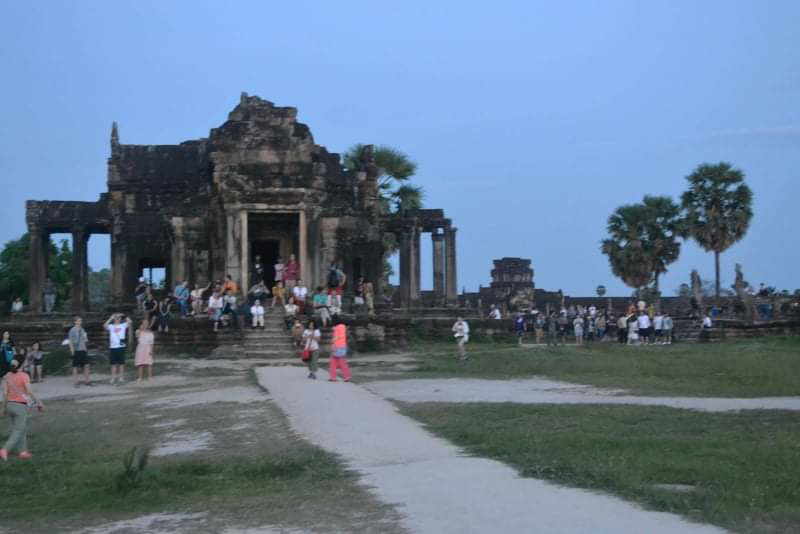
Southern Library, the main western entrance and great causeway can be seen in the background. The sun has barely risen and already a throng of visitors are enjoying the ruins.
The northern library, beyond the sandstone causeway. The ruin is a little more intact than its southern counterpart.
With patience the crowds passed and I was able to get a few pictures of the causeway leading up to the Terrace of Honor, the cruciform terrace before entering the first level of the temple.
The terrace makes a great stop for a photo of the temple acting as a splendid backdrop.
Viewing the galleries, from the Terrace of Honor, the bas-reliefs are a tour all unto themselves. Most people seem to be content to rush towards the central spire, so the galleries are not as typically crowded. Notice the new stone in the balustrade, bottom left.
A Naga-headed balustrade from the Terrace of Honor. Much of the intricate stonework is still visible, even though it has been exposed to centuries of the elements. Some of the patch work is visible, even as it has retained much of the original stone work, it has still be broken apart and reassembled.
My Photo Tour of Angkor Wat
Down this gallery is depicted scenes from the Battle of Lanka. In a future visit I will expand more on this, likely in a new post. I didn’t devote enough time to really delve into the extensive bas-reliefs.
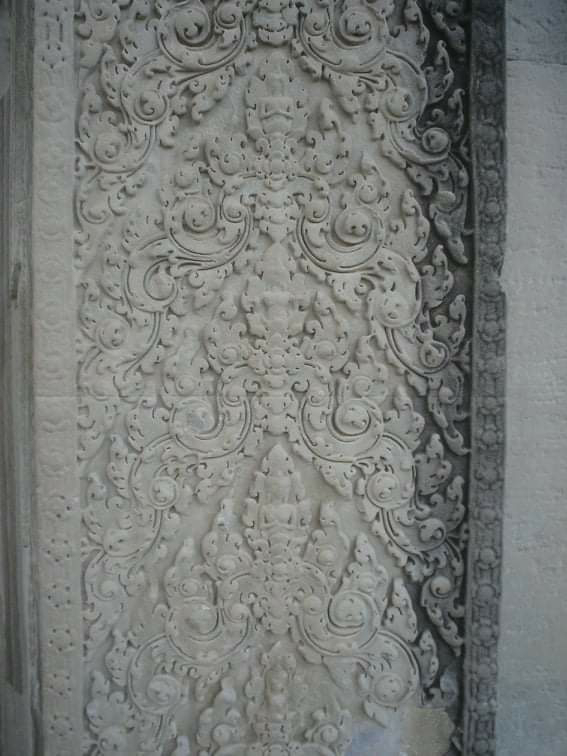
Angkor Wat boasts some of the best preserved stonework I have seen in any of the Khmer temples I have visited. Interesting finely done pattern.
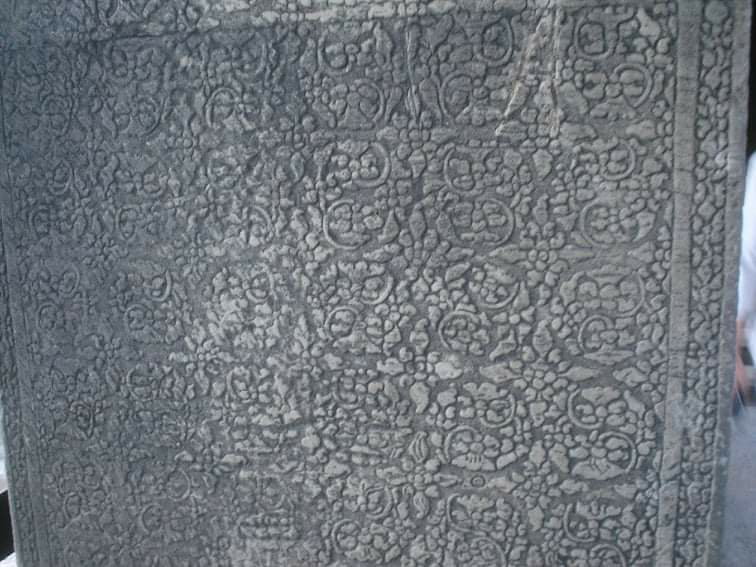
This pattern is a repetitive floral arrangement. I am speculating on how this was done, but I can envision a pattern “stamped” in ink and repeated, then chiseled out. I would like to know for sure one of these days.
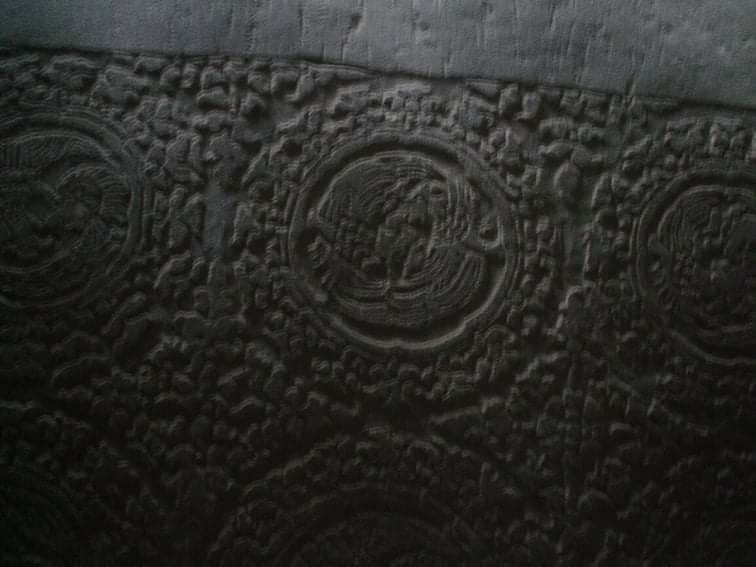
A simple and neat pattern, working in stone has always impressed me.
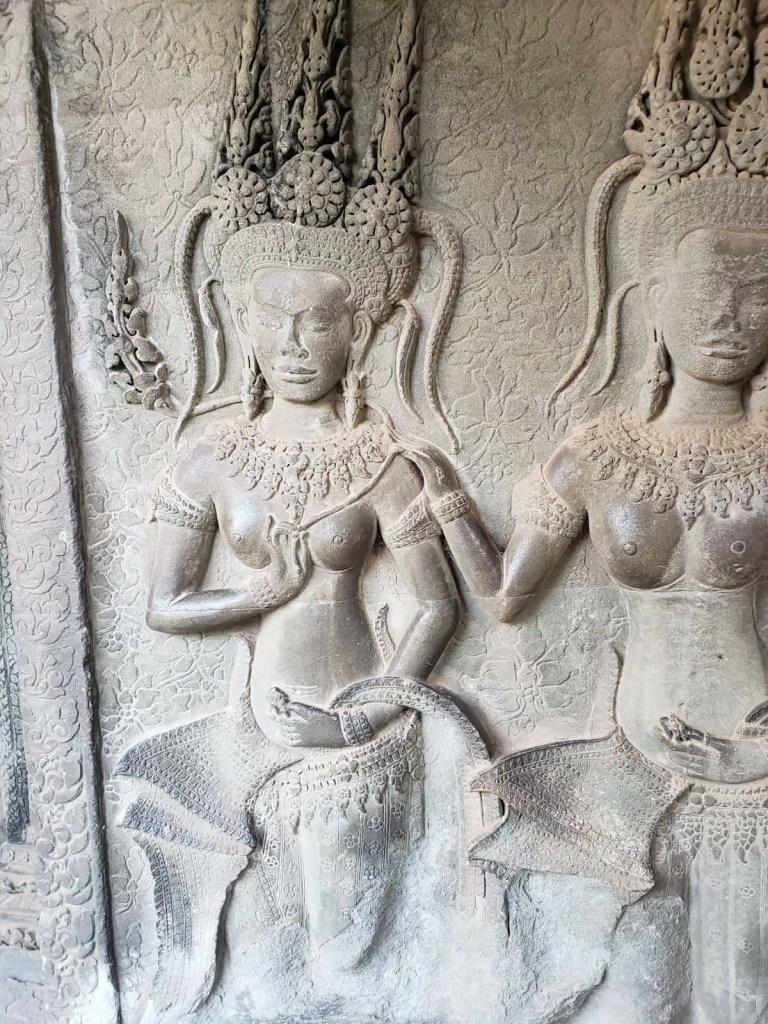
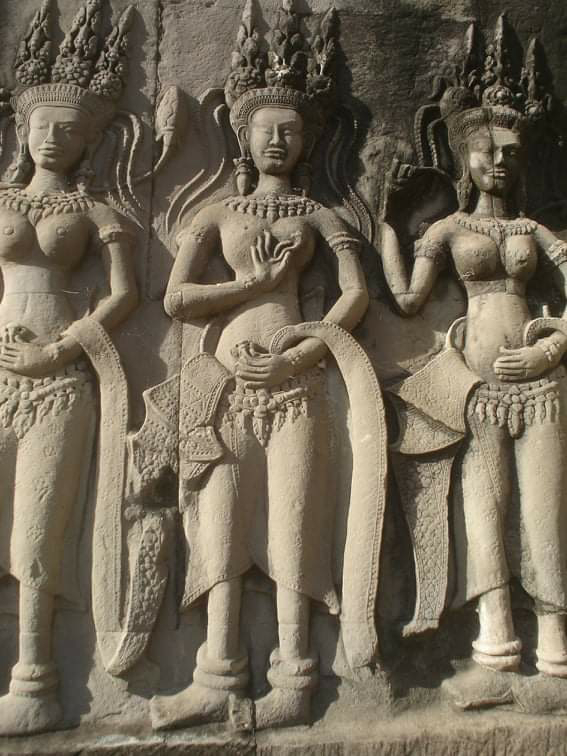
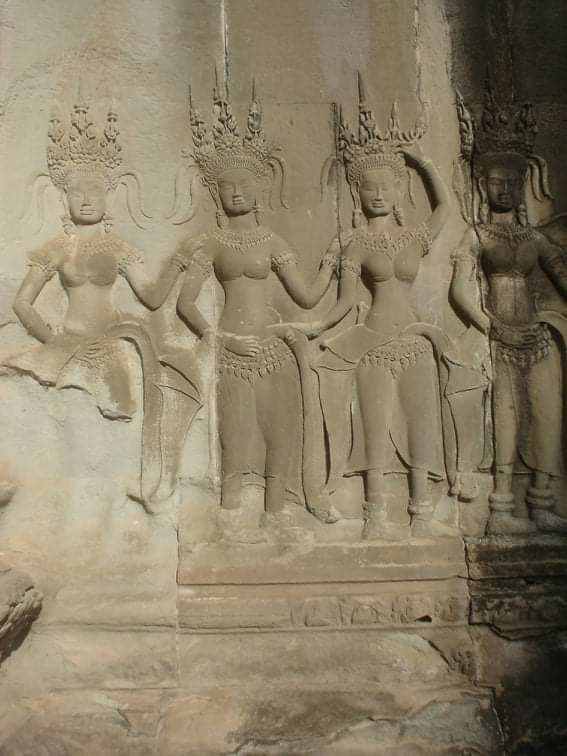
The devatas are set deep into the wall. This gives them more shapely attributes and makes them visually impressive. A post dedicated to Asparas and Devatas will be forthcoming.
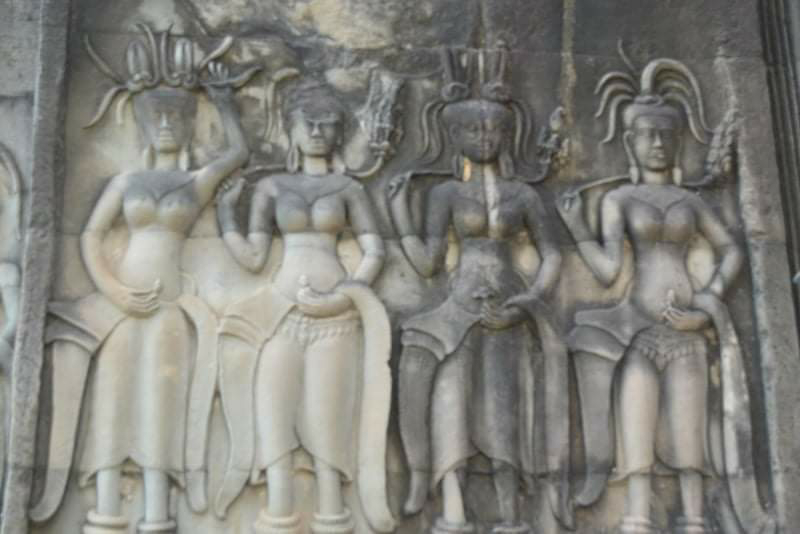
Four Devatas with intricately done crowns and head pieces. No two Devatas are alike, even if they share similar headdresses or hair styles. It is as if each one represented a single individual. This must have only added to the effort required to chiseled out the stone without the same repeated template.
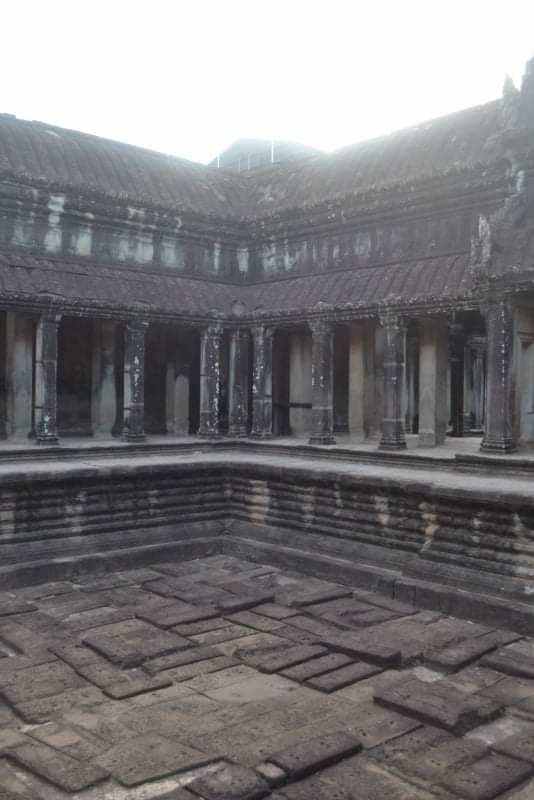
This portion of the temple is known as the ‘Thousand Buddha Gallery’ and there are several stone Buddha statues in various states of disfigurement along the walls. This would have been a ceremonial cleansing basin that leads into the inner sanctum of the temple.
Some extensive damage at the base of these Devatas, but I bet you didn’t even notice. The breast of several of them have been polished by the fondling of past and present visitors.I admit I may have gone overboard with the selection of the Devata photos for this post, each was so unique I felt I had to.
Most of the Devatas have a solemn expression, these two, not so much.
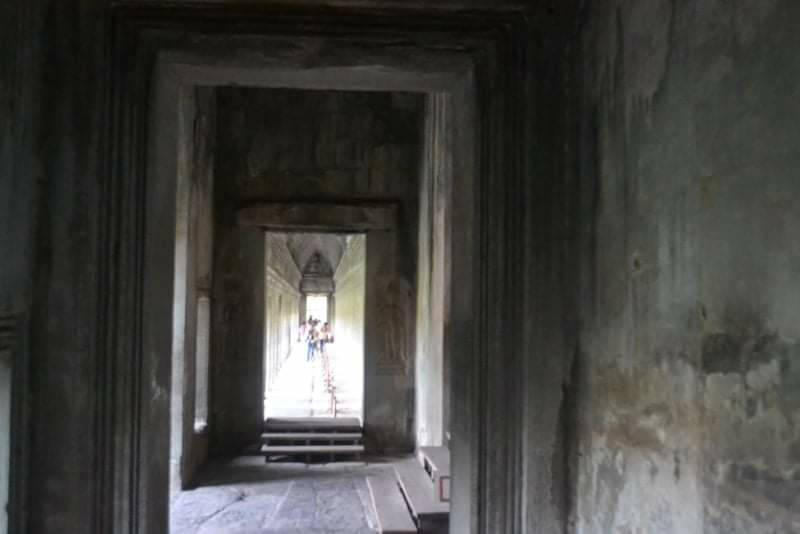
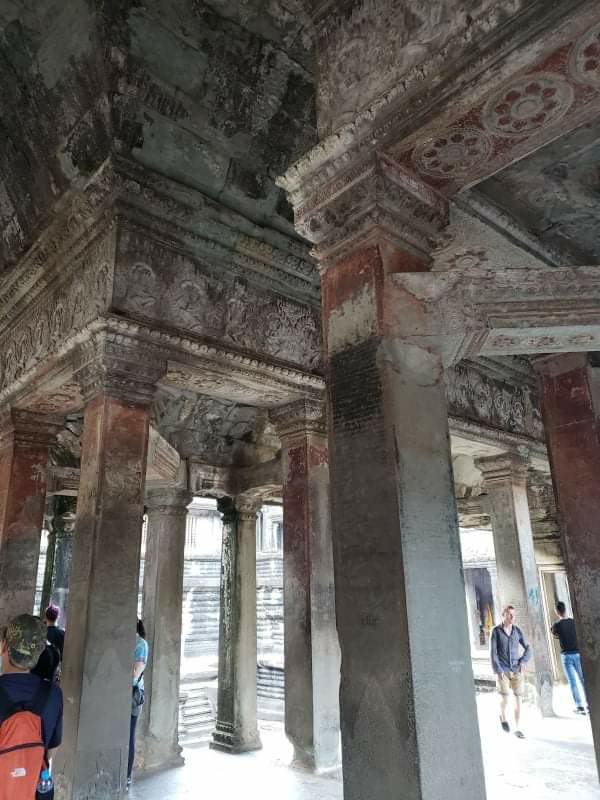
A lot can be said of the outward appearances of the temple, but not much is posted about what is holding it together. Not every space is sandstone blocks heaped upon one another. Many of the spaces are an intricate stone lattice structure as seen above. The temple was not left in naked unfinished stone either, and the painted interior from its heyday can still be seen in parts of the temple.
The ancient world was full of color, and I find it fitting that the Khmer were no different and that the stone surfaces we see now were once decorated in colorful paint.
A slightly different angle, which shows the ceiling and stone layering technique used.
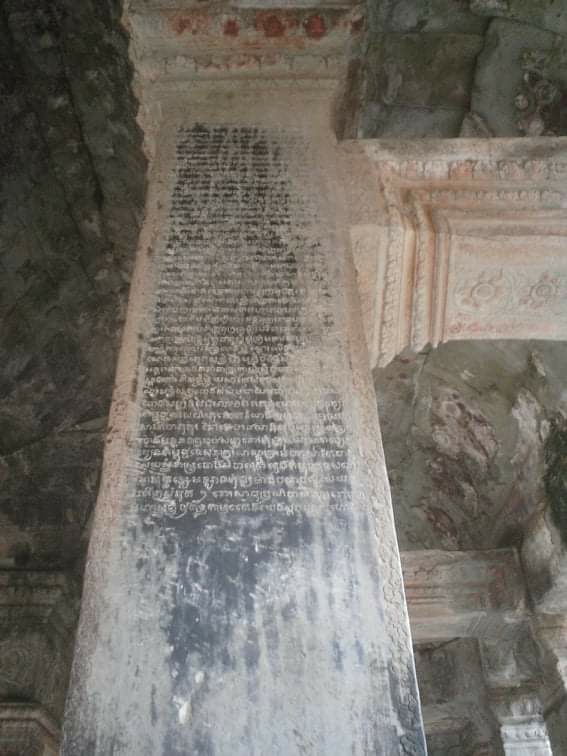
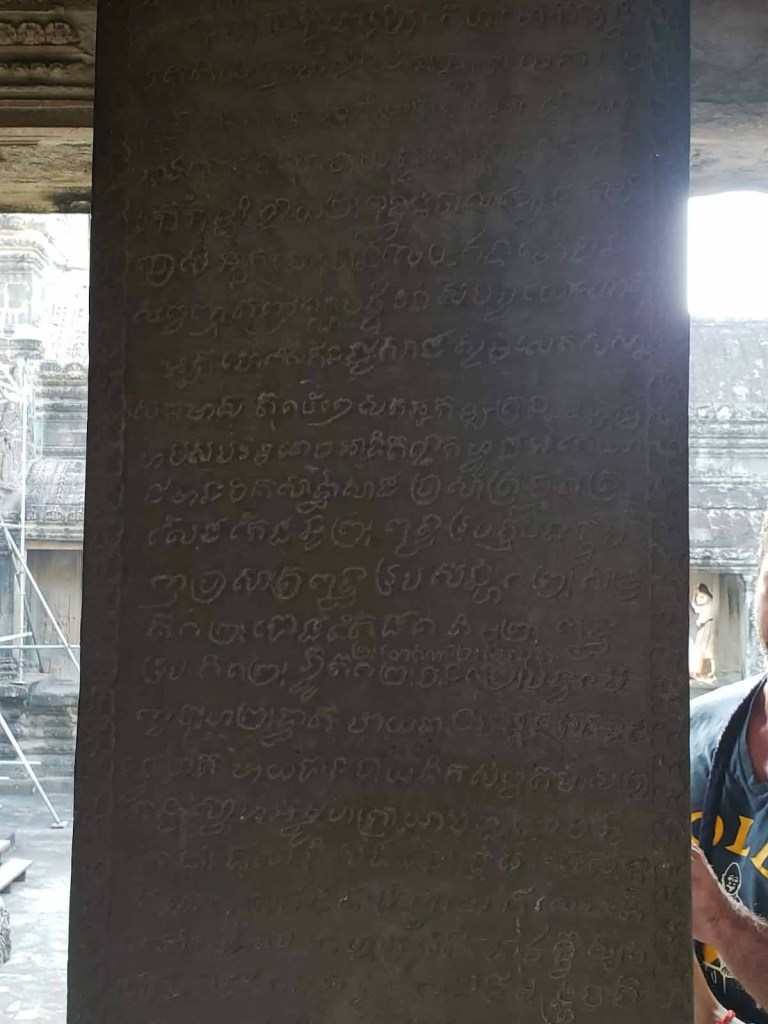
Many of these interior columns have inscriptions carved into them. Regrettably I have no idea what they read, though I assume it would relate to the construction and virtuous deeds of the god-king, Suryavarman II.
With the stone left smooth I wonder if a portion of this may have been covered over and only the exposed stone below has any decoration chiseled into the stone. The stone work of the Khmer artisans has long left an impression on me.
Moving up to the next level from the Thousand Buddha Gallery to the second level of the temple. The emptied basin below adds a greater height perception.
Stepping into the enclosed courtyard of the second level, more Devatas in greater concentration appear. There are over 1500 Devatas, sometimes labeled Asparas, along the gallery walls of the second level courtyard, each one is unique. These also appeared more animated than the ones from the lower levels.
The courtyard of the second tier is dominated by the central prang, or the Bakan. Only one stairway up is opened to the public on on the east end. Most visitors appeared to be heading directly here, so the line is long, but plenty of opportunities for people watching and photos from across the courtyard.
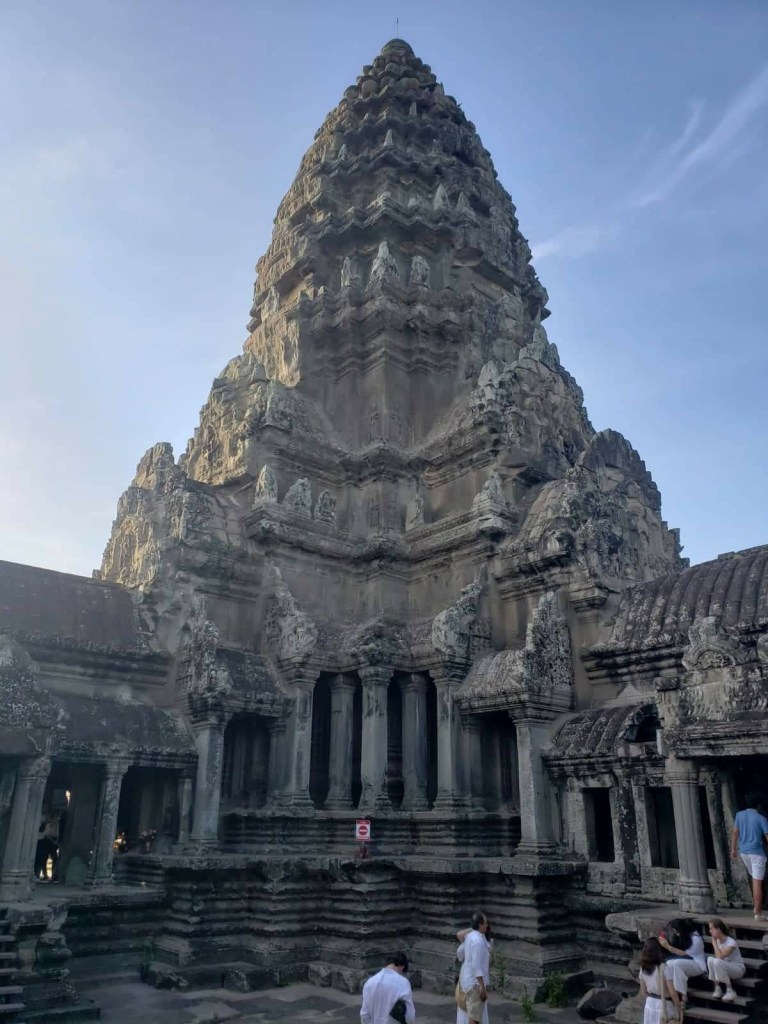
The center piece of the temple, as taken from the end of the line. The central prang reaches 213 meters, and is elaborately adorn with fine stonework. The five towers form a quincunx pattern, a representation of the holy Mount Meru, home of the Hindu Pantheon. My apologies, I love the word ‘quincunx’ and wanted to somehow incorporate it into the post.
A great vantage point for viewing the surrounding area. There are a total of twelve flights of stairs, but only one is opened to the public to access the third tier of the temple. Only a small group is allowed up at one time.
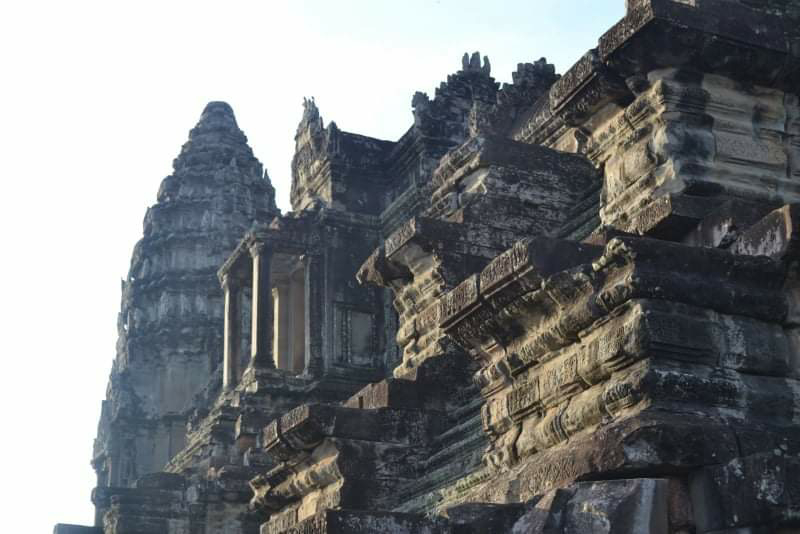
One of the angle towers of the central tier, five in total which represent Mount Meru.
An imposing tower, adorn with more Devatas, the details of the stone work can be seen even at a distance, and this zoom shot does those no justice at all.
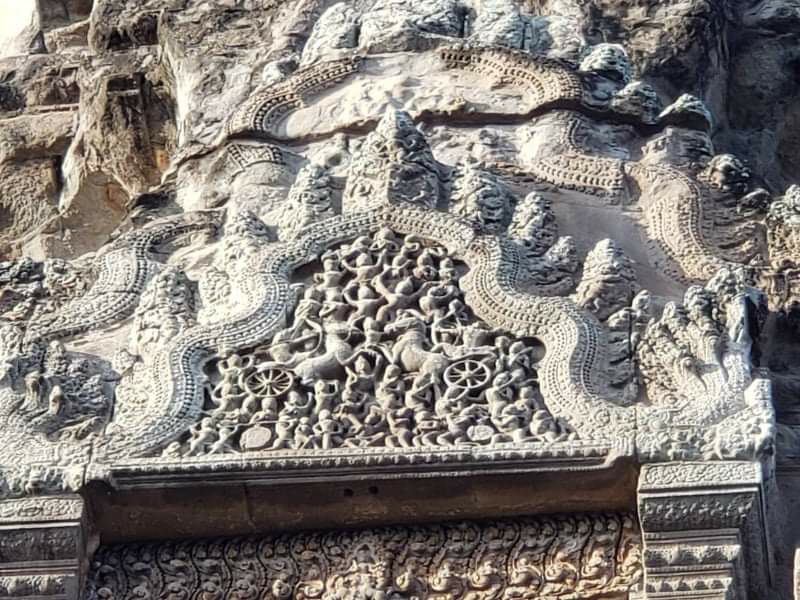
I would love to recreate this portal in my own home one day. An absolutely exquisite stone lintel with some of the most elegant Khmer stone work I have yet seen. Dating of Khmer temples can often be done by simply looking at the lintel styles used.
Another look at detail of the stone work. The stone ‘gable’ is a scene stealer and is also elaborately adorn in fine stone work.
After having made my way up from the courtyard below, up on the third tier of the temple. Looking out over the opening and next tower beyond.
An unfinished Devata, I am unfamiliar with the techniques used in masonry work, but looks like the template was made, and light chisel work to get the basic outline before work was abandoned.
A stone stele in the third tier of the temple.This is written in an older form of Khmer, and my very basic understanding of the alphabet I can see one or two letters I might know. Time to hit the books perhaps?
Looking west, over the second level courtyard and beyond the grand causeway. The Western Gopura can be seen off in the distance.
The devatas of the third tier are just as detailed as elsewhere in the temple. Little space was left unadorned without some interesting stonework.
A detailed view of one of the support columns.
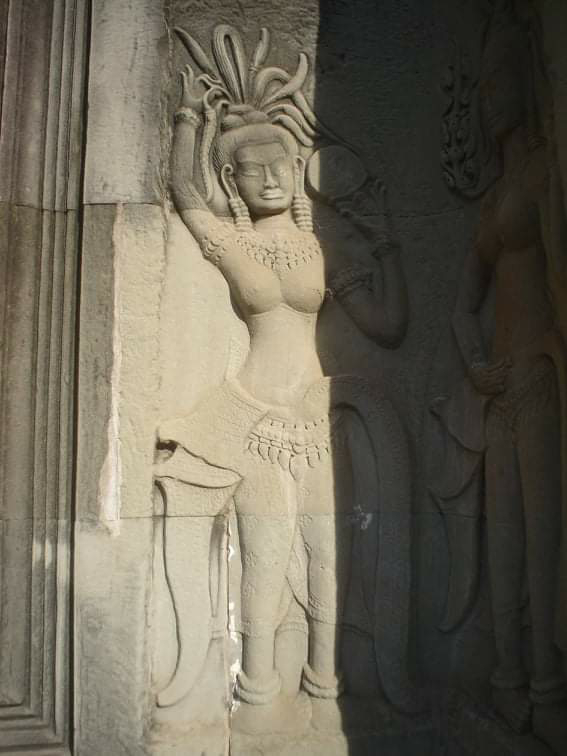
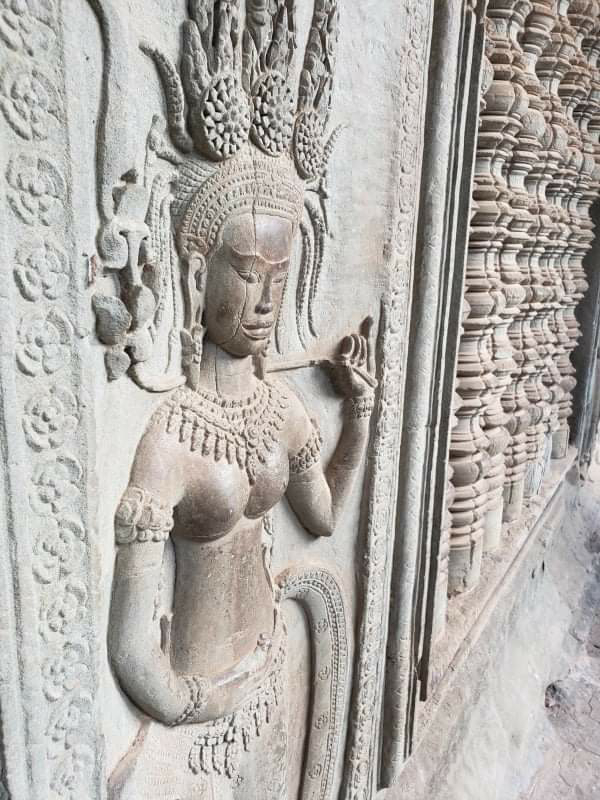
I like this Devata, simple pose, framed by two windows, and not set upon a pedestal. It is simple in execution and not overly elaborate but still catches your eye.
The Bakan is made up of five towers, laid out in a quincunx form pattern. Each ornately decorated and well preserved.
A column, with a fine traditional pattern.
The background of these Devatas has an interesting floral pattern. Even the clothing has patterns etched into them.
These Devatas have not escaped the apparent touch of many hands. It does give them an interesting contrast in the colors of the stone.
Back on the second tier courtyard. These Devatas are sporting interesting headdresses.
The fabric patterns of these Devatas
Panning to the right, admiring the craftsmanship of the ancient artisans.
Before exiting from the second tier courtyard its worth the time to circle around and admire a few of the Devatas, some of which stand out more than others. This could be because of a headdress, hair style, or damage that adds a certain je ne sais quoi.
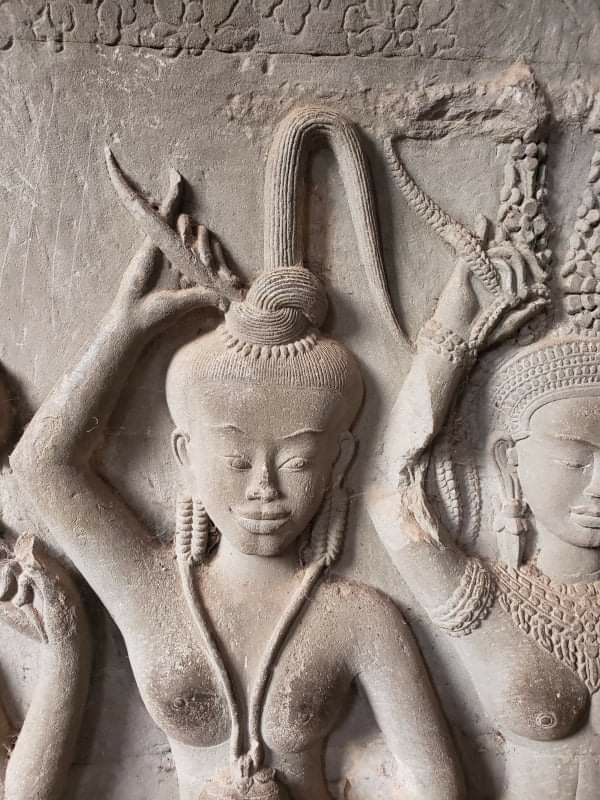
Of the Devatas, this hair style or head piece is the one I enjoy the most.
Stepping out of the second tier down to the first tier.
The Southern Thousand God Library, located in the first tier open space.
Returning to the Thousand Buddha Gallery and the collection of Buddha statues placed within.
Many of the Buddha statues have been defaced. There has been centuries of war, Hindu vs. Buddhist factional-ism, and looting, so its hard to pin the culprits.
Another defaced, but still venerated, statues of the Buddha.
A black-market once existed for Buddha heads from Cambodia. Sadly few were spared.
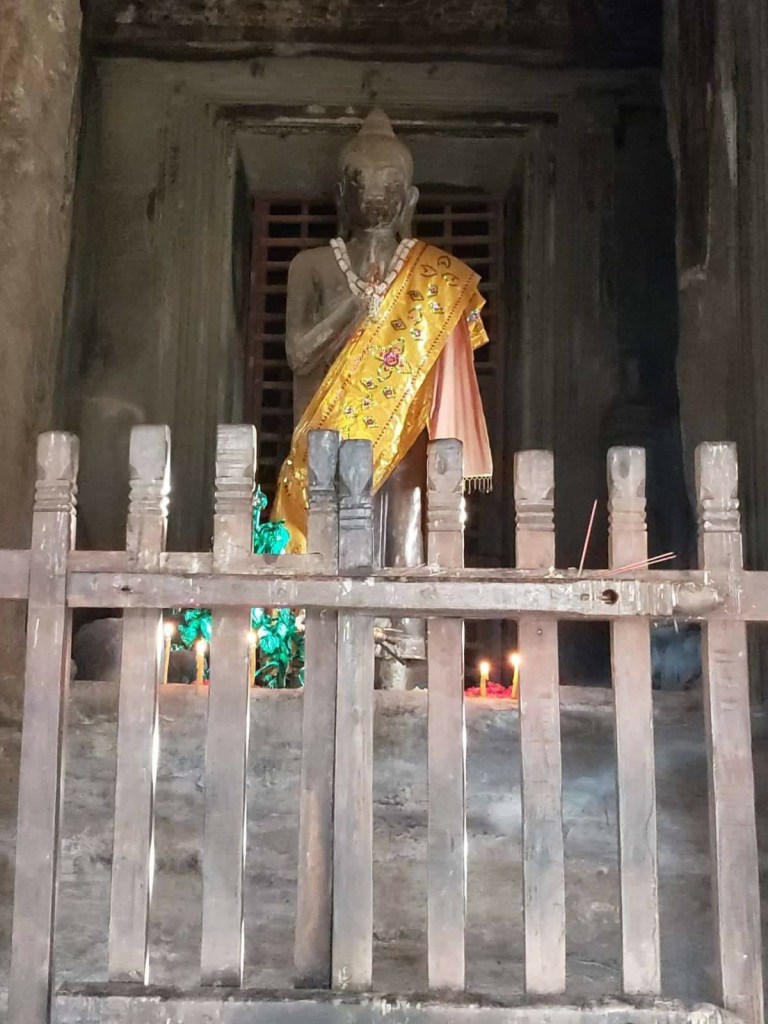
A fenced off Standing Buddha statue enshrined at Angkor Wat.
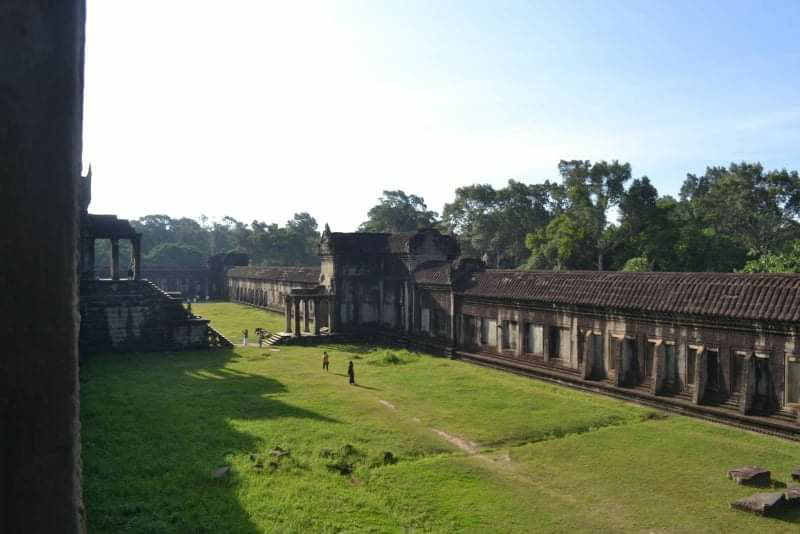
The Southwest angle tower and outer gallery.
Before bidding farewell to the temple, one last look back over the moat.
More Devatas and Asparas
Angkor Wat is renowned for its stone work and depiction of the Devatas and Asparas which adorn its venerable walls. There is of course much to be seen along all of the gallery walls throughout the temple, but the Devatas tend to dominate the attention.
I admit I was also captivated by the allure of the many Devatas here. The biggest take away is that each one is unique, and no ‘one size fits all’ template appears to have been used. Each one stands out for that reason.
A little closer up, the hair style is definitely catching. I also noticed that this Devata has different facial features from her sisters. By this time, the Khmer Empire subjugated many various ethnicities, so it could be that this figure represents one of the many other ethnicities of the Khmer Empire, Perhaps the newly arrived Siamese.
This is one I would like a reproduction panel of, nicely bordered, elaborate adornments, a nice representation of the many Devatas of Angkor Wat.
While “Asparas” depict mythological heavenly women, most of the female images in the Khmer carvings found at Angkorian ruins are in fact termed “devata,“ sacred women who wield some mystical power here in our earthly realm. There are Asparas, but these are usually depicted as dancing female figures or figures who float or fly, without having both feet firmly planted to the ground. I shamefully never noticed the difference in my reading but looking back at all of my notes, it was briefly noted but never seemed to click. Perhaps the word Asparas conveys a more mystical or serene image than ‘Devata’ does.
While age has exposed the seams between the blocks, appreciation to the skill of the artist who had to work the stone without causing breaks. Even the fabric patterns have weathered well.
Last parting of the Devatas, I will try to have a post dedicated to uncovering more about them, and hopefully learn more about their significance.
Further Reading and Viewing
There were several reference materials I have used before my trip in planning, and also chanced upon several other sources that I feel have been quite informative that I hope will also help inspire or inform anyone who wants to make a trip. As prices and itineraries change, I won’t be making any suggestions along those lines, but for the history and reading up more on the books and videos to watch, I will list those below.
Reading:
National Geographic; Vol. 161 No. 5, MAY 1982
Michael Freeman & Claude Jacques, Ancient Angkor, River Books Ltd, Bangkok, 1999
Charles Higham, The Civilization of Angkor, Weidenfeld & Nicolson, Great Britain, 2001
David Chandler, A History of Cambodia, Third Addition, Silkworm Books, Thailand, 2003
Podcasts and Videos:
The Khmer Empire – Fall of the God Kings; Fall of Civilizations Episode 5, 2020
The Buried Mysteries of Angkor Wat, The City of God Kings; TimeLine, Produced by Darlow Smithson Productions.




























 Lost in Linklandiya
Leave a comment